
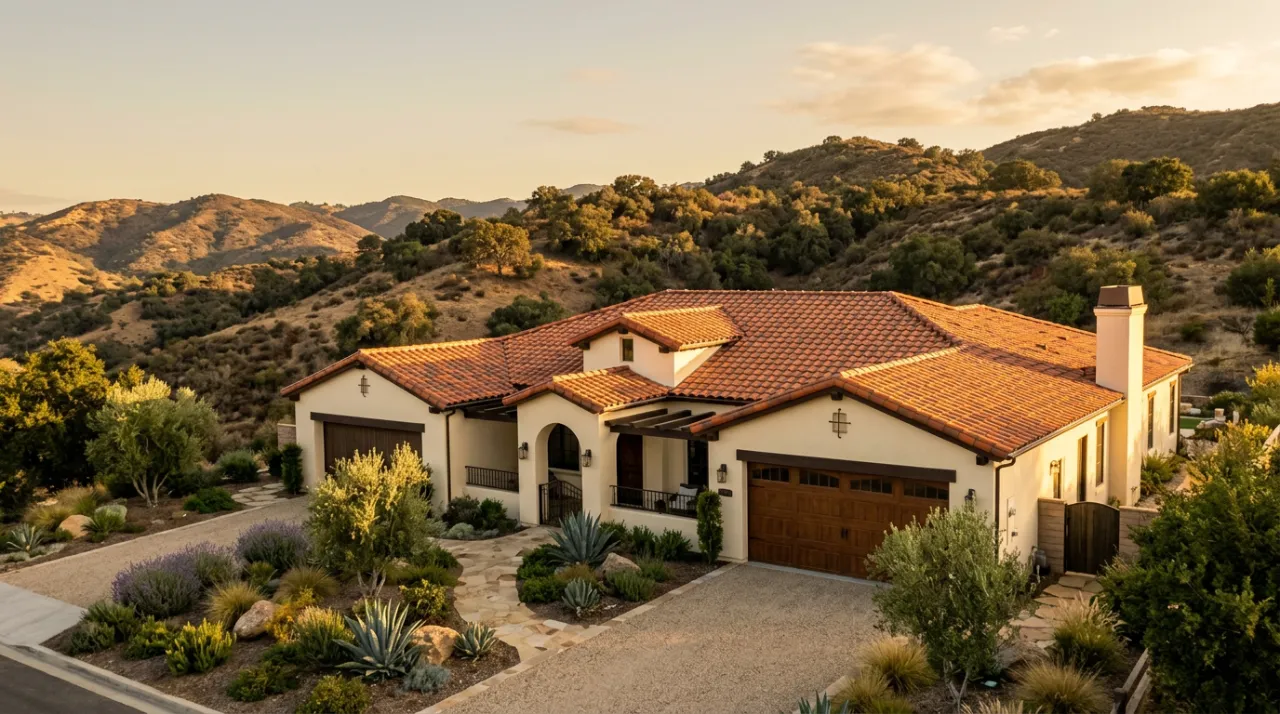
In March 2025, the California Department of Forestry and Fire Protection released updated Fire Hazard Severity Zone maps for cities across the state. For Orange County homeowners, the change wasn’t just a line on a map. Neighborhoods that weren’t considered high-fire-risk a year ago — including parts of Irvine, Anaheim Hills, and unincorporated OC — are now under California’s Wildland-Urban Interface Fire Code.
If your home sits in one of these newly designated areas, three things just changed at once. Your roof now needs to meet stricter fire code at the next replacement. Your insurance carrier likely already knows. And the cost and complexity of reroofing your home went up.
This guide breaks down what California’s 2026 roof code actually requires, which Orange County neighborhoods are now affected, what a Class A fire-rated roof really is, and what to do if you’re suddenly inside the new zone.
What Changed in 2026: California’s New Fire Hazard Maps
The 2025 map update is the biggest single shift to California’s wildfire-prone area designations in nearly two decades. For OC homeowners, the practical effects show up in three places: your building permits, your insurance renewal, and your home’s resale value.
CAL FIRE’s March 2025 LRA Map Update
On March 24, 2025, CAL FIRE released new Fire Hazard Severity Zone (FHSZ) maps for the Local Responsibility Areas — the jurisdictions where local governments, not the state, hold fire protection authority. That includes nearly every Orange County city.
The new maps replaced versions that had stood since 2011. Two factors drove the redesign: improved predictive modeling for ember travel and ignition probability, and statutory requirements that CAL FIRE update FHSZ designations to reflect current wildfire science and 14 years of additional fire data.
The result is that thousands more California properties — including many in OC — moved into Moderate, High, or Very High Fire Hazard Severity Zone (VHFHSZ) categories. You can verify your property’s status directly on CAL FIRE’s official FHSZ map viewer before assuming anything.
Orange County Adoption Timeline
Cities and counties have a legal window to adopt CAL FIRE’s recommended maps. Irvine moved first, adopting in June 2025 with the maps taking effect July 23, 2025. Anaheim, Orange, and Yorba Linda followed through the summer. Orange County’s unincorporated areas adopted the maps via Ordinance 25-015 on August 26, 2025.
Once your jurisdiction adopts, WUI roof requirements apply — both for new construction and for reroofs that cross the code’s recover and replacement thresholds.
Which Irvine Neighborhoods Are Now in the VHFHSZ
Eight Irvine neighborhoods saw substantial fire-zone expansion under the 2025 maps. The grid below shows which ones now fall under updated WUI roof requirements. If you live in any of them — or own property in the foothill corridors adjacent to them — the 2026 code applies to your next reroof.
Why Your Roof Is the Most Vulnerable Part of Your Home
In post-fire studies of California wildfires, structural ignition pathways trace back to roofs more often than any other component. The mechanism is usually not direct flame contact. It’s embers — wind-blown burning brands that can travel a mile or more ahead of an active fire front, landing in roof valleys, lodging under tile edges, and gathering in gutters filled with dry debris.
A standard roof failure during a wildfire follows a predictable sequence. Embers accumulate in unprotected attic vents, gutter debris, or gaps between tile and underlayment. Ignition starts in the attic space or the underlayment itself, often without anyone outside the home seeing flame.
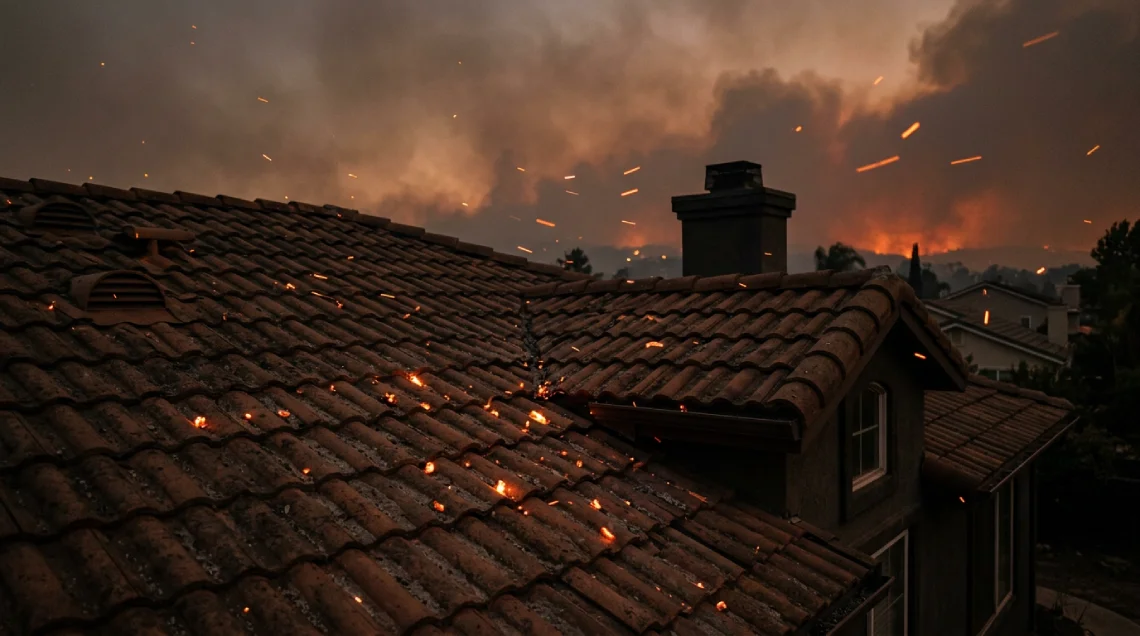
By the time fire is visible at the roofline, the assembly has already failed beneath the surface. The roof covering — the visible top layer — can look fine while a fire is growing underneath it.
This is the reason California’s WUI code doesn’t just regulate the roof covering. It regulates the entire roof assembly: covering, underlayment, sheathing, vents, eaves, and penetrations. A Class A shingle on top of a non-compliant assembly may still allow ignition. We’ll come back to the assembly-versus-covering distinction shortly.
California’s 2026 Roof Code: WUI + Title 24 in Plain English
The 2026 California Building Standards Code introduced a structural change that most homeowner-facing articles haven’t caught yet. Here’s the short version of what governs your roof now.
The CWUIC (Formerly “Chapter 7A”) — What Changed January 1, 2026
If you’ve seen older articles refer to “Chapter 7A of the California Building Code,” that reference is now technically out of date.
As part of the 2025 code cycle (effective January 1, 2026), the California Building Standards Commission moved Chapter 7A’s substantive requirements into a new standalone code: the California Wildland-Urban Interface Code (CWUIC), Title 24 Part 7. The material standards for fire-rated roof coverings, ember-resistant vents, and assembly testing now live in CWUIC Chapter 5.
The old Chapter 7A still exists as a placeholder that points to the new code — so the requirements didn’t go away, they moved.
When Code Triggers Apply: New Build, Tear-Off, Recover, Repair Thresholds
You don’t have to comply with the 2026 roof code on every project. The triggers are: any new construction in a designated FHSZ; full tear-off and replacement of an existing roof; recover work affecting more than 50% of the total roof area; and large repairs above the contiguous square-footage threshold set by your local building department (often around 300 square feet).
Localized repairs below those thresholds usually don’t trigger compliance — but always confirm with your local jurisdiction before assuming. The cost difference between a code-triggering reroof and a non-triggering repair is significant, so this question is worth asking before the work starts.
What Is a Class A Fire-Rated Roof?
“Class A” is the highest fire-resistance rating a roof covering or assembly can achieve under California code. It’s also the rating now required across most of OC’s WUI zones. Here’s what it actually means, and how it’s tested.
Class A, Class B, Class C — The Three Roof Fire Classifications
The California Building Code classifies roof coverings and assemblies into three fire-resistance categories. Class A is designed to resist severe fire exposure — the kind generated by an active wildfire with wind-driven embers. Class B handles moderate exposure. Class C handles light exposure. An unrated roof offers essentially no certified fire protection. In WUI-designated areas of California, only Class A meets code.
How Class A Roofs Are Actually Tested (ASTM E108 / UL 790)
Class A ratings come from a specific standardized test: ASTM E108, also known as UL 790. The test isn’t a single experiment — it’s a sequence of three.
The Spread of Flame Test measures how far a flame travels across the covering under a simulated 12 mph wind, with a 1,400°F gas burner applied for up to 10 minutes. The Intermittent Flame Test cycles flame on and off across the assembly to simulate variable fire conditions.
The Burning Brand Test — the most demanding of the three — places a 12-inch by 12-inch by 2.25-inch piece of dried Douglas fir on the roof and lets it burn for roughly 1.5 hours. To pass Class A, the assembly must survive four consecutive burning brand cycles without ignition spreading beneath the covering.
It’s the Assembly, Not Just the Material
This is the detail most homeowner articles miss. A Class A rating applies to the complete tested assembly — covering, underlayment, and sheathing combined — not just the visible shingle or tile. Two roofs using the same Class A shingle can have entirely different real-world fire performance depending on what’s underneath.
When you’re getting reroof bids, the right question isn’t “Is the shingle Class A?” It’s “Is the full assembly Class A, and can you provide the manufacturer’s tested assembly documentation?” Reputable contractors will answer yes to both without hesitation.
Class A Roofing Materials for Orange County Homes
Different Class A materials make sense for different OC neighborhoods, budgets, and architectural styles. Here are the four most common Class A options for OC homes, plus one material category to avoid.
Concrete Tile (Most Common in OC)
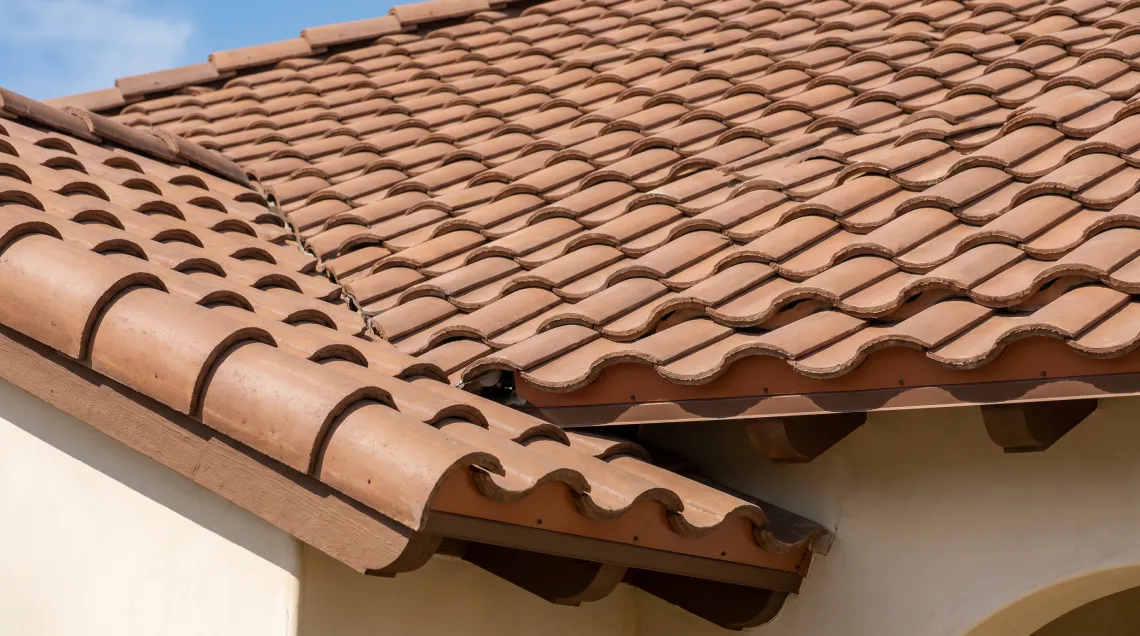
Concrete tile is the default Class A choice for most OC homes for one practical reason: it matches the Spanish, Mediterranean, and contemporary Mediterranean architecture that defines much of the county.
Concrete tile is inherently noncombustible, achieves Class A without special underlayment additions in most assemblies, lasts 40 to 50 years, and handles OC’s mild climate well. The main tradeoffs are weight (requires verifying the existing roof structure can carry it) and higher up-front cost than asphalt shingle alternatives.
Clay Tile
Clay tile is the premium variant of the same category. It costs more than concrete tile, weighs about the same, and lasts longer — 50+ years is realistic on a well-installed clay tile roof in OC.
Visually, it produces the deepest authentic Mediterranean and Spanish-revival looks. Most OC clay tile installations are Class A out of the box. If you own a higher-end home in Newport Beach, Coto de Caza, Laguna Beach, or one of the master-planned communities with strict architectural guidelines, clay tile is often a near-default choice.
Standing-Seam Metal Roofing
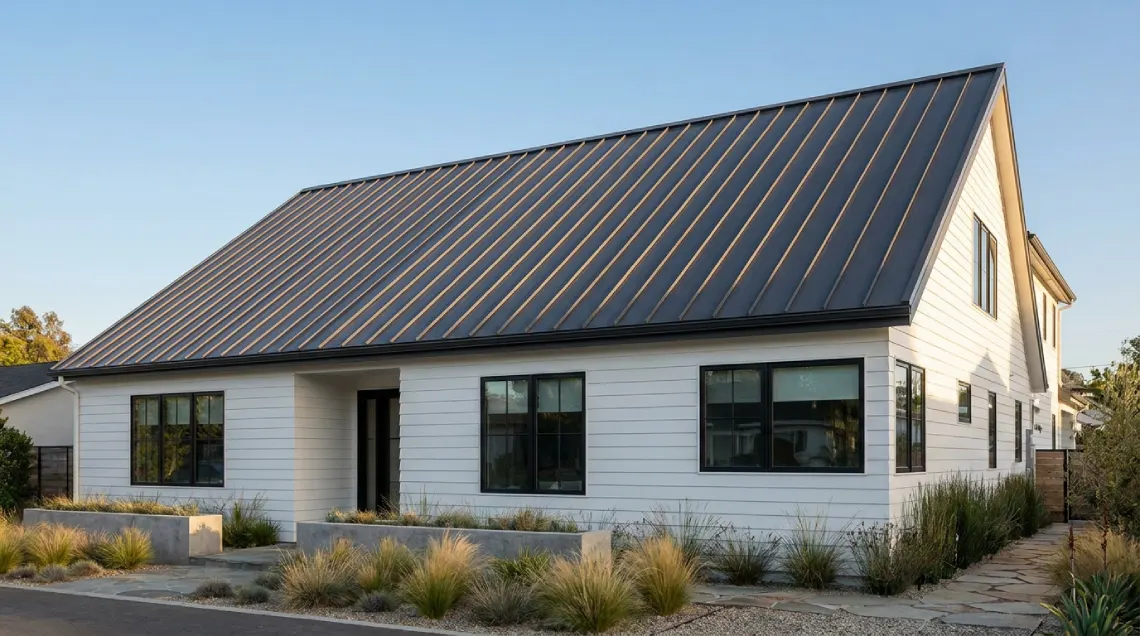
Metal roofing — typically standing-seam steel or aluminum with a Kynar or similar finish — has been growing in OC over the last five years, particularly on contemporary and modern-farmhouse designs.
It’s inherently noncombustible, achieves Class A easily as part of a complete assembly, lasts 40 to 60+ years depending on the metal, and reflects solar heat efficiently (a Title 24 cool-roof advantage we’ll cover shortly). The drawback is up-front cost — typically higher per square than concrete tile — and the more specialized installation labor it requires.
Architectural Fiberglass Asphalt Shingles
The most budget-friendly Class A option is asphalt shingles — specifically the architectural (dimensional) variant with a fiberglass mat. Most modern architectural fiberglass shingles from major manufacturers carry a Class A rating when installed as part of a manufacturer-specified Class A assembly (there’s the assembly point again). Lifespan is shorter than tile or metal — typically 20 to 30 years — but the cost-to-Class-A ratio is the best of any common option.
Materials to Avoid in WUI Zones
Wood shake and wood shingle roofs — even fire-retardant-treated wood (FRTW) products — should be avoided for OC homes in or near the new VHFHSZ designations. Although some FRTW wood shake assemblies can pass Class A testing, real-world performance during California wildfires has been inconsistent, and insurance carriers are increasingly declining or non-renewing homes with wood roofs regardless of treatment. Even where wood shake remains code-permitted, it’s a poor risk-management choice for an OC home in 2026.
You can also see a recent Papaya roof replacement project showing how we approach Class A reroofs in Southern California.
Beyond the Roof Covering — WUI Assembly Requirements
A Class A roof covering is the visible part of the story. The CWUIC also regulates the parts of your roof system that most homeowners never see — and those details often determine whether your roof actually survives a fire.
Ember-Resistant Vents (Eaves, Gable, Soffit)
Roof and attic vents are the most common ember-ignition pathway in California wildfires. Embers blown by wind can sail into a standard attic vent and ignite stored material or insulation inside the structure.
The CWUIC requires ember-resistant vents — specifically vents tested and listed under ASTM E2886 — at all eave, gable, soffit, and roof-mounted vent locations in WUI-designated areas. Retrofitting these is one of the lowest-cost, highest-impact upgrades you can make ahead of a full reroof.
Class A Underlayment, Eave/Fascia Detailing, and Penetration Treatment
The assembly requirements also cover Class A-rated underlayment beneath the covering, noncombustible or fire-rated detailing at the eave and fascia line, skylight assemblies tested for Class A performance, and noncombustible flashing around all roof penetrations (pipe boots, HVAC curbs, chimneys).
On reroof projects, these details get inspected — and they’re where uncertified work most often fails final permitting. A contractor who’s done this work before will spec these correctly in the bid; a contractor who hasn’t will either miss them or add them as costly change orders mid-project.
Class A Roof Assembly — Layer Cross-SectionAttic Space1. Class A Roof Covering2. Class A Underlayment3. Sheathing4. Ember-Resistant Vent5. Noncombustible Penetration FlashingAll five components together must pass ASTM E108 / UL 790 to qualify as a Class A assembly.
Class A roof assembly cross-section showing the five WUI-regulated components.
Title 24 Cool Roof Layer — Energy Code for OC
The 2026 code requirements aren’t only about fire. California’s Title 24 Energy Code, also updated in the 2025 cycle (effective January 1, 2026), governs how much solar heat your roof can absorb. For OC reroofs, Title 24 compliance applies in parallel with WUI compliance — and both have to be met on the same project.
OC’s Climate Zones — Zone 6 (Coastal) vs. Zone 8 (Inland)
Orange County straddles two of California’s 16 Title 24 climate zones. Coastal cities — Newport Beach, Huntington Beach, Costa Mesa, Laguna Beach — fall mostly into Zone 6. Inland cities — Anaheim, Yorba Linda, Orange, and most of Irvine — fall into Zone 8.
The distinction matters because steep-slope cool-roof prescriptive requirements apply only in Zones 4 and 8 through 15. Translation: in coastal OC (Zone 6), a steep-slope reroof generally does not trigger cool-roof requirements prescriptively. In inland OC (Zone 8), it does.
Verify your specific parcel through the California Energy Commission’s Title 24 standards or your local building department before bidding the project.
Steep-Slope vs. Low-Slope Prescriptive Requirements + CRRC Rating
Low-slope roofs trigger cool-roof requirements across all OC climate zones. Steep-slope roofs trigger only in Zone 8. When cool-roof compliance applies, the product must be rated by the Cool Roof Rating Council (CRRC) and meet minimum solar reflectance and thermal emittance thresholds.
Your contractor files Title 24 compliance forms (CF1R for prescriptive design, CF2R for installation, CF3R for verification) with your permit application.
The practical opportunity here: many Class A concrete tiles, metal roofs, and lighter-toned architectural shingles also meet Title 24 cool-roof thresholds. Meeting both codes in a single product is a major project-cost advantage. See our Garden Grove exterior renovation for an example of bundled exterior-envelope compliance work.
The Insurance Reality for OC Homeowners
The 2026 code change matters even more outside the building permit office. California’s homeowners insurance market has been tightening for five straight years, and your roof’s fire classification is now central to whether you can get — or keep — coverage.

Why Insurance Carriers Care About Your Roof Class
Carriers underwrite based on a property’s expected fire-loss probability. A home in a newly designated VHFHSZ with a Class A roof carries materially lower expected loss than the same home with an unrated or Class C roof.
Major carriers — State Farm, Allstate, Farmers, and Liberty Mutual among them — have updated underwriting guidelines since 2023 to weight roof class, ember-resistant vent presence, and overall home-hardening status more heavily. Some carriers now require Class A documentation at policy bind or renewal for properties in any designated WUI zone.
The verifiable documentation matters here as much as the actual roof — a Class A assembly without the paperwork still creates a problem at renewal.
Non-Renewals, New Underwriting, and California FAIR Plan in 2026
If you’re an OC homeowner who received a non-renewal notice in the past 18 months, your roof class may have been a factor.
The California Department of Insurance tracks non-renewal patterns and California has consumer protections that delay some renewals in declared disaster areas — but the underlying market reality is that insurability is increasingly tied to verifiable Class A compliance.
Homeowners who can’t get coverage from a standard carrier often end up on the California FAIR Plan, the state-backed last-resort fire insurance pool. FAIR Plan policies cover fire only, cost substantially more than standard coverage, and require separate wraparound policies for other perils.
Demonstrating Class A compliance with permit documentation, photos, and manufacturer assembly specs is the most direct path back to standard-market eligibility.
What Orange County Homeowners Should Do Now
Whether your roof is fine, aging, or already on the carrier’s radar, here’s how to sequence the next 12 months.
If You’re in a Newly Designated VHFHSZ
First step is confirmation. If your address falls inside a newly designated zone per your city’s adopted ordinance, the second step is a roof assessment.
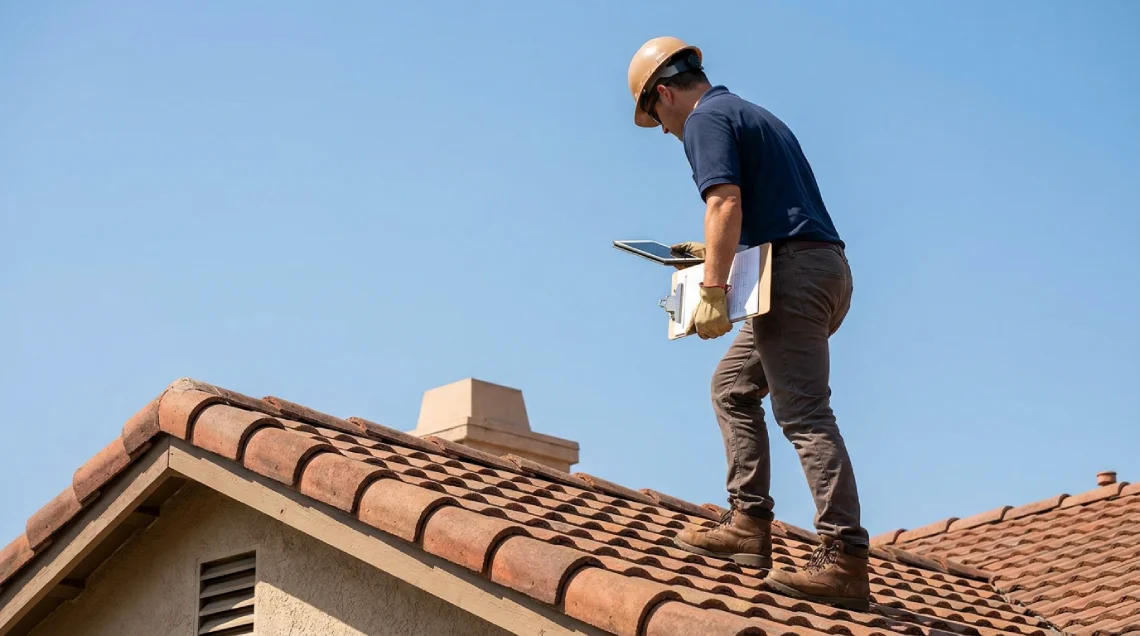
The question isn’t whether your current roof has a visible leak — it’s whether the existing assembly is Class A and whether your attic and eave vents are ember-resistant. A licensed contractor with B-classification authority (general building) can evaluate both.
Document everything: photos, manufacturer specs from any recent reroof, permit records. This documentation is what your insurance carrier will ask for at the next renewal cycle.
If You’re Planning to Sell (Pre-Listing Roof Certification)
OC buyers in 2026 are asking pointed questions about roof age and fire compliance. Listings with documented Class A assemblies and recent permit records sell faster and survive buyer-insurance contingencies cleaner. If your roof is 15+ years old or you don’t have records of Class A specification, a pre-listing roof certification from a licensed B-classification contractor can prevent the deal-falling-apart phone call mid-escrow.
The Permitting & Inspection Sequence in OC
For a code-compliant reroof in OC, the sequence is: contractor pulls a re-roof permit with the local building department; tear-off and decking inspection (if required); assembly install; final inspection with Title 24 CF2R/CF3R verification; permit close-out.
In jurisdictions like Irvine, this typically takes 2-4 weeks end-to-end on a standard residential job — assuming your contractor pulls permits correctly. Skipping permits to save time creates exactly the documentation gap that breaks future insurance and resale transactions.
7 Quick Tips for OC Homeowners Navigating the New Fire Maps
A scannable summary of the highest-leverage moves you can make before your next reroof or insurance renewal:
On every Class A roof replacement in Orange County, Papaya Construction delivers full WUI assembly documentation — every shingle spec, every underlayment certification, every assembly testing document.
Frequently Asked Questions
The Bottom Line for OC Homeowners
California’s 2026 roof code reflects a structural shift: wildfire risk has moved out of canyons and into neighborhoods, and the building code, the insurance market, and the resale market are catching up at the same time.
For Orange County homeowners, the practical response is the same — verify your zone, audit your current assembly, and plan your next reroof around Class A compliance from the beginning.
Papaya Construction handles the verification, the permitting, and the full Class A assembly install — with the documentation package your insurance carrier and future buyer will both ask for.