

Replacing a roof in Orange County in 2026 costs between $14,000 and $36,000 for most single-family homes, with the final number driven almost entirely by your material choice. Concrete and clay tile dominate the OC market — more than two-thirds of homes here have tile roofs — and homeowners switching from tile to shingle or vice versa usually face structural costs that wipe out any short-term material savings.
That’s the cost answer. The harder question is what else you’ll navigate before work starts.
Most OC homes — about 85% — sit inside an HOA with its own architectural review process. California’s new Wildland-Urban Interface code took effect January 1, 2026, and now applies to every reroof in a designated fire zone. Title 24 cool roof requirements kick in any time you replace more than half of your roof. And city-by-city permit processes vary widely across Irvine, Anaheim, Santa Ana, Newport Beach, Huntington Beach, and Mission Viejo.
This guide covers all of it — real 2026 pricing for each material, the OC-specific factors that move your final number, and the regulatory layers most contractors won’t mention until you’ve already signed.
2026 Roof Replacement Cost in Orange County at a Glance
The following pricing reflects 2026 installed cost ranges for a typical 2,000–2,800 sqft Orange County home, including tear-off, disposal, materials, labor, and standard permits. Installation costs scale with roof size, which contractors measure in roofing squares (1 square = 100 sqft of roof surface). WUI fire zone projects, HOA tile-match requirements, and decking repairs are quoted separately.
Pricing reflects current Orange County market rates as of mid-2026. Final estimates depend on roof pitch, tear-off layers, decking condition, WUI compliance, and permit jurisdiction.
Why Orange County Is Tile Country
There’s no single “best roofing material” for Orange County homes. The right choice depends on your existing structure, your HOA’s approved-product list, your fire-zone designation, and how long you plan to stay in the home.
That said, OC’s regional answer leans heavily toward tile — and the reasons are worth understanding before you weigh alternatives.
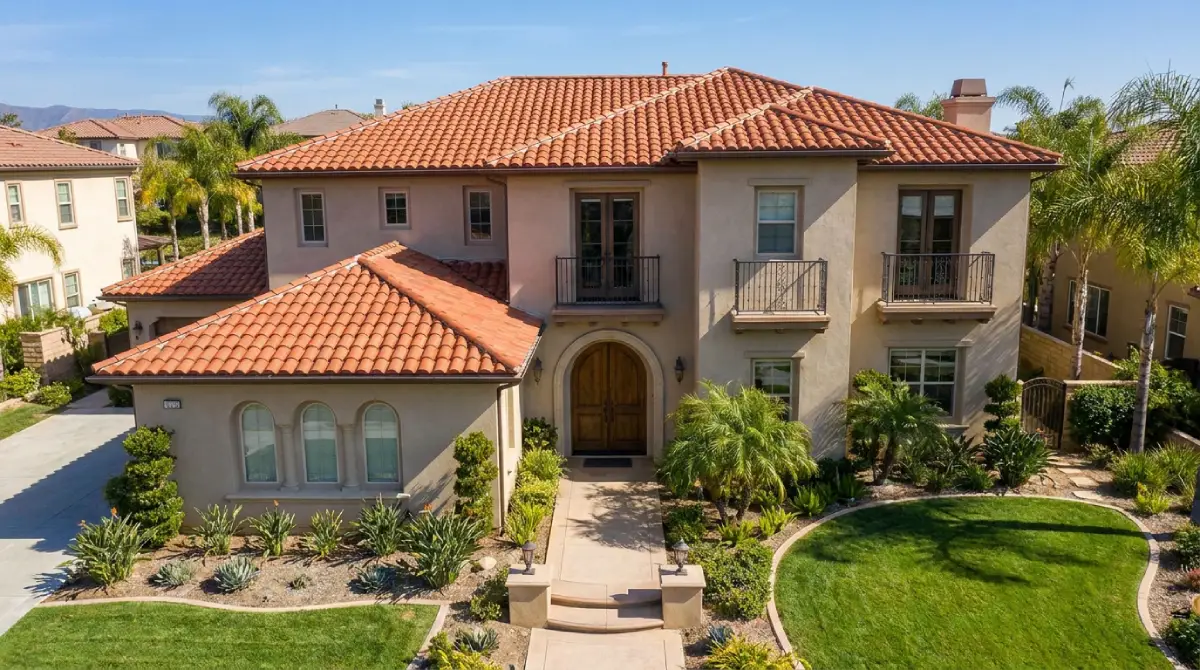
Drive through any OC neighborhood built between 1965 and 1995 — Mission Viejo, Anaheim Hills, Yorba Linda, Irvine, Lake Forest, San Juan Capistrano — and you’ll see the same roofline almost everywhere. Concrete and clay barrel tile, terracotta and earth-tone color blends, Mission Revival and Mediterranean profiles.
Three reasons this happened.
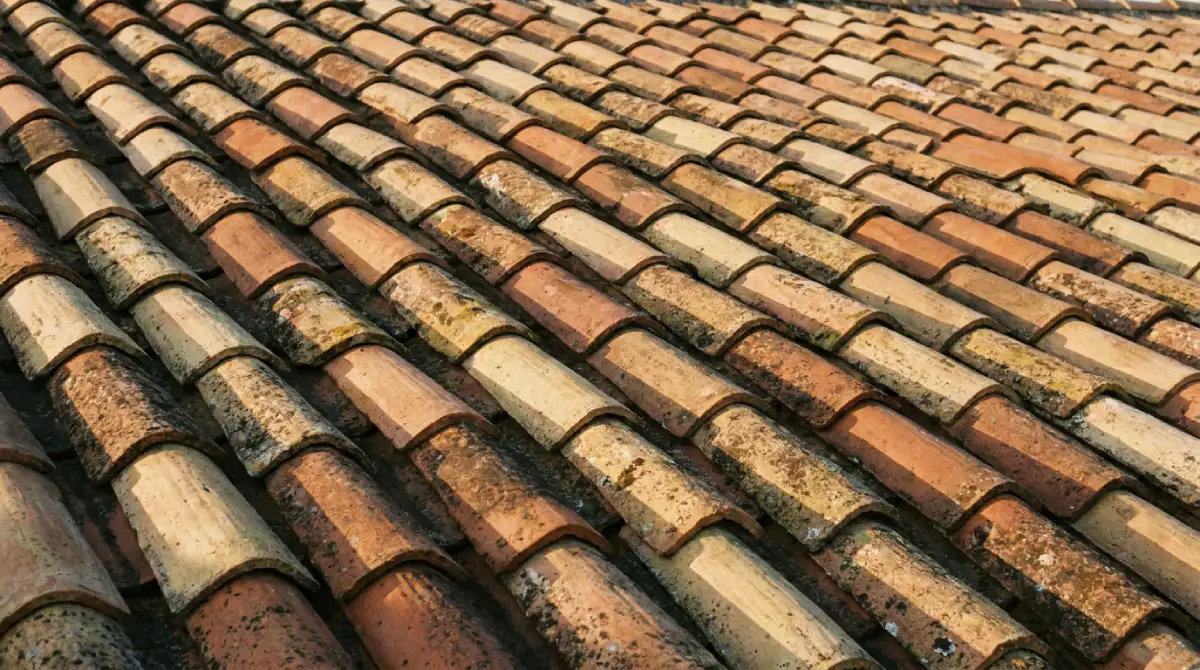
First, the region’s mid-century master developers — Irvine Company, Mission Viejo Company, Rossmoor Corporation — standardized on concrete tile during the build-out era to support the Mediterranean aesthetic that defines OC residential architecture today.
Second, California’s Title 24 energy code rewards the thermal mass of tile, which keeps attics measurably cooler in OC’s hot inland valleys (Irvine, Anaheim, Yorba Linda) and reduces HVAC load year-round.
Third, tile carries an inherent Class A fire rating, which matters in canyon-adjacent communities like Anaheim Hills, Yorba Linda, Lake Forest, Mission Viejo, Trabuco Canyon, and Coto de Caza — all of which fall partially or fully within Very High Fire Hazard Severity Zones. As of 2026, Class A is no longer a nice-to-have in those areas; it’s a code requirement.
What Drives Your Final Price in Orange County
The per-square-foot ranges above are a starting point. The line items that move the final number up or down are predictable and mostly local:
- Tear-off layers. California Building Code prohibits more than two layers of roofing in most cases, so older OC homes with multiple existing layers require a full tear-off — adding $1,000–$3,000 to the bottom line.
- Disposal fees. Tile, asphalt, and old underlayment go to different disposal streams under OC’s construction-waste diversion rules, and dumpster fees add $300–$900 to most projects. Tile is heavier and costs more to haul than shingle.
- Decking condition. Pre-1990 OC homes frequently show plywood sheathing damage once the old roof comes off — water staining, dry rot, or termite damage. Damaged decking replacement runs $2–$4 per square foot, and on a typical home that adds $2,000–$5,000 if widespread.
- Roof pitch and complexity. Steep slopes and pitches (8/12 and above), multiple dormers, skylights, valleys, and hip-and-ridge intersections increase labor cost by 20–40%. Custom homes in Newport Coast, Crystal Cove, and Shady Canyon often have complex roof geometry that drives this premium.
- Underlayment grade. Synthetic underlayment outperforms felt under Southern California’s UV and heat exposure but adds $0.50–$1.50 per square foot. On tile roofs, underlayment is what actually keeps water out — the tiles are the wear layer.
- Permit jurisdiction. Permit fees vary across OC cities, and some require additional plan check for tile re-lay or weight changes. We cover the city-by-city breakdown below.
- HOA architectural review. Most OC HOAs require tile-for-tile color and profile matching, which can mean sourcing discontinued tiles or paying a premium for the closest current match.
- WUI compliance. Homes in Very High Fire Hazard Severity Zones now fall under the new Title 24 Part 7 code (more on this below). Ember-resistant vents, Class A assemblies, and noncombustible flashing typically add $2,000–$5,000 to a standard project.
Tile-for-Tile Replacement vs. Switching Materials
Most OC homeowners replacing a tile roof in 2026 are replacing it with another tile roof — not switching materials. There are two reasons for this, and both come down to math.
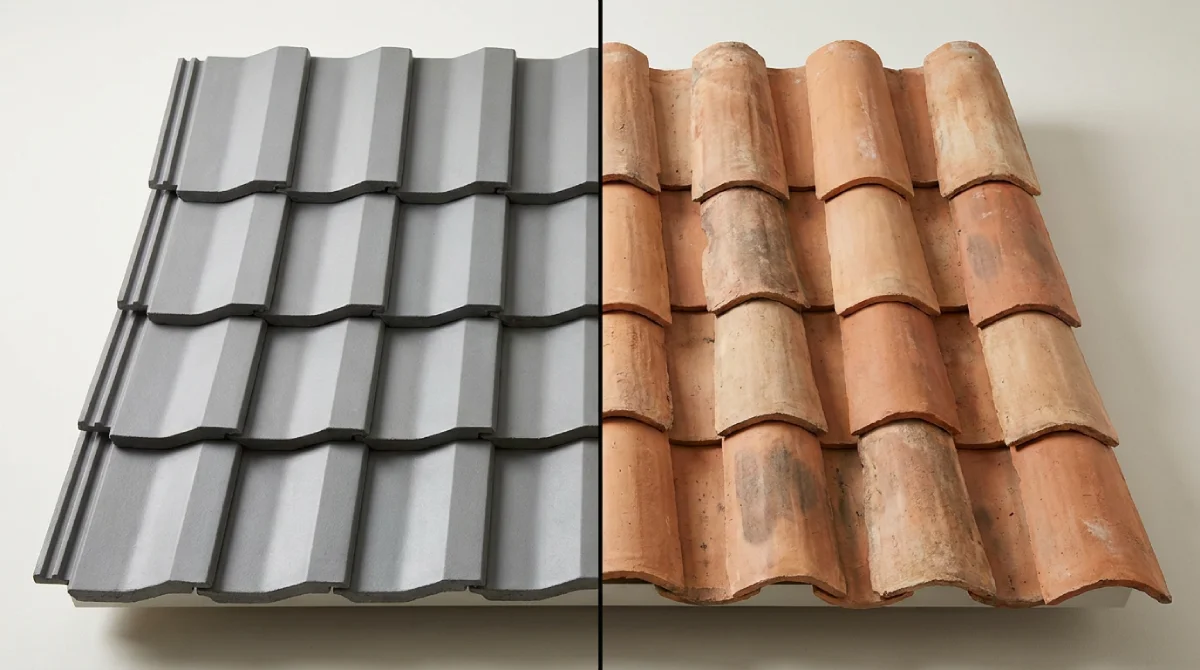
On the structural side: concrete tile weighs roughly 9–12 pounds per square foot. Asphalt shingle weighs 2–3 pounds per square foot.
If you switch from tile to shingle, you’ve removed enough load that the upgrade is structurally trivial.
But if you switch from shingle to tile, you’re adding 6–10 psf of new dead load to a roof that wasn’t engineered for it. That requires structural reinforcement, an engineered design, and a more demanding permit path — realistically $4,000–$10,000 added to the project.
On the HOA side: most OC HOAs require tile-for-tile replacement with approved color and profile match. Switching to shingle (or vice versa) is generally not approved without a hardship case or specific design review. If you’re in an Irvine Company village, Ladera Ranch, Rancho Santa Margarita, Coto de Caza, or any of the master-planned south OC communities, plan on staying with your existing material category.
The exception worth knowing: a tile re-lay. If your existing tiles are intact, a roofer can carefully remove them, replace the deteriorated underlayment underneath, and re-install the original tiles. This typically saves $8–$12 per square foot compared to full tile replacement. Some breakage is inevitable, so sourcing matching replacement tiles is part of the scope — but on a 2,400 sqft roof, a re-lay can save $20,000 or more.
The HOA Factor: 85% of OC Homes
About 85% of Orange County homes sit inside a homeowners association.
Architectural review is the single most overlooked planning step in any reroof project. For most OC HOAs, the city will not issue a building permit without an approved Architectural Review Committee (ARC) letter attached to the application.
Typical ARC review timelines run 3–6 weeks for a well-prepared submission. Complex projects or non-conforming material selections can stretch this to 8–10 weeks with revisions. Here’s the practical sequence:

- Identify your HOA and pull their architectural guidelines. Many south OC HOAs publish approved-product lists for roofing.
- Submit to the ARC first. Plans, materials, color samples, manufacturer specs, profile drawings.
- After ARC approval, submit the building permit to the city. Attach the ARC letter to the application.
- Begin work after both approvals. Starting before either approval can mean fines, stop-work orders, and forced removal at the homeowner’s expense.
A few examples of how this plays out across major OC communities:
- Mission Viejo Environmental Association (MVEA) governs most homes in the city of Mission Viejo. ARC approval is required before any work begins; starting without approval triggers a $175 fee, and unapproved changes may have to be removed. MVEA pre-approves six paint manufacturers (Behr, Benjamin Moore, Dunn-Edwards, Frazee, Sherwin-Williams, Vista) and maintains its own color palette.
- Irvine Company villages — Woodbridge, Northwood, Turtle Rock, University Park, Portola Springs, Great Park neighborhoods and dozens of others — operate through Irvine Community Design Council (ICDC) architectural review. Tile-for-tile replacement is standard; material switches typically require formal design review.
- Ladera Ranch, Rancho Santa Margarita, Coto de Caza, and Talega maintain strict color-and-profile match standards and approved-product lists. Some communities require samples on the roof for visual review.
The single most important question to ask your contractor before signing: “Have you pulled an ARC submittal for my specific community before, and how long did approval take?” The answer separates locally experienced roofers from contractors who learn the process on your job.
California Title 24 and the New WUI Code (Effective January 1, 2026)
This is where 2026 looks meaningfully different from 2025. Two state regulatory layers now apply to most OC roof replacements: the long-standing Title 24 cool roof requirement (Part 6, the Energy Code) and a brand-new consolidated Wildland-Urban Interface Code (Title 24 Part 7).
Title 24 Cool Roof Requirements
If you replace more than 50% of your roof area, California Title 24 Part 6 requires the new roof to meet cool-roof reflectance and emittance minimums certified by the Cool Roof Rating Council (CRRC). Concrete and clay tile typically meet these standards in light and medium colors without modification. For darker shingles, you may need to use a CRRC-certified product or accept an alternative compliance path through additional attic insulation or radiant barrier installation.
This requirement applies in every OC city. It’s enforced through your CF-1R Title 24 documentation submitted with the building permit.
The New California Wildland-Urban Interface Code (CWUIC) — Title 24 Part 7
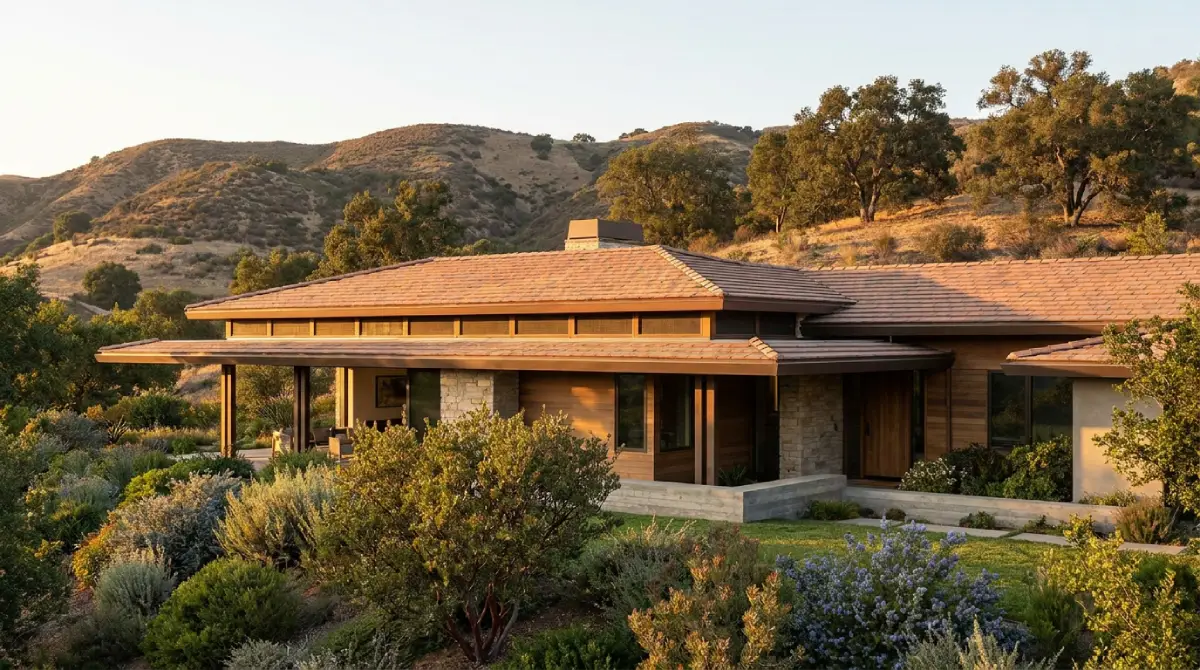
As of January 1, 2026, California consolidated all of its wildfire construction rules into a single new code: the California Wildland-Urban Interface Code (CWUIC), now adopted as Title 24 Part 7.
This is one of the most significant California building code restructurings in decades. The previous fragmented rules in CBC Chapter 7A, California Residential Code Section R337, and California Fire Code Chapter 49 have all been relocated into Chapter 5 of the new CWUIC.
For OC homeowners, the practical change is procedural rather than substantive — the underlying material requirements are similar to the old Chapter 7A, but everything now lives in one place. If your home is in a designated Very High Fire Hazard Severity Zone, your reroof must comply.
OC areas where the CWUIC applies most heavily:
- Anaheim Hills, Yorba Linda Hills (eastern canyon edges)
- Lake Forest and Mission Viejo canyon-adjacent neighborhoods
- Trabuco Canyon, Silverado, Modjeska
- Coto de Caza, Las Flores, Wagon Wheel
- Laguna Beach canyon and bluff communities
- Portions of San Clemente and Dana Point
Confirm your designation by entering your address at the CAL FIRE Fire Hazard Severity Zone Viewer. Coastal and walkable cities — Seal Beach, central Huntington Beach, Costa Mesa, central Newport Beach — are generally not in mapped zones.
What CWUIC compliance requires for a reroof:
- Class A roof covering (concrete tile, clay tile, most metal, and Class A asphalt shingles qualify; wood shake is effectively banned)
- Ember-resistant vents listed to ASTM E2886 with 1/16″–1/8″ mesh openings
- Noncombustible, corrosion-resistant valley and ridge flashing (minimum 26-gauge sheet metal)
- Gutters covered with mesh to prevent ember accumulation
- Documented assembly compliance from a State Fire Marshal–listed product
Expect $2,000–$5,000 in additional cost for a fully compliant WUI roof assembly compared to a standard installation outside the zone.
Reroof Permit Process by Orange County City
Permit fees and timelines vary across OC cities. Here’s how the main jurisdictions handle residential reroofs in 2026, after the 2025 California Building Standards Code took effect January 1.
One detail every OC homeowner should know: roofing permits can only be pulled by a C-39 (roofing) or B (general) licensed contractor with active workers’ compensation insurance. Verify any contractor’s license at the California Contractors State License Board before signing — the CSLB can assess civil penalties up to $5,000 per violation for unlicensed work.
Every OC city requires a final inspection before the permit can be closed. This typically happens after the roof is fully installed and includes verification of underlayment, flashing, ventilation, and (where applicable) WUI assembly compliance. Don’t make the final payment to your contractor until the final inspection has passed and the permit is closed in the city’s system.
Repair or Replace? A Decision Framework
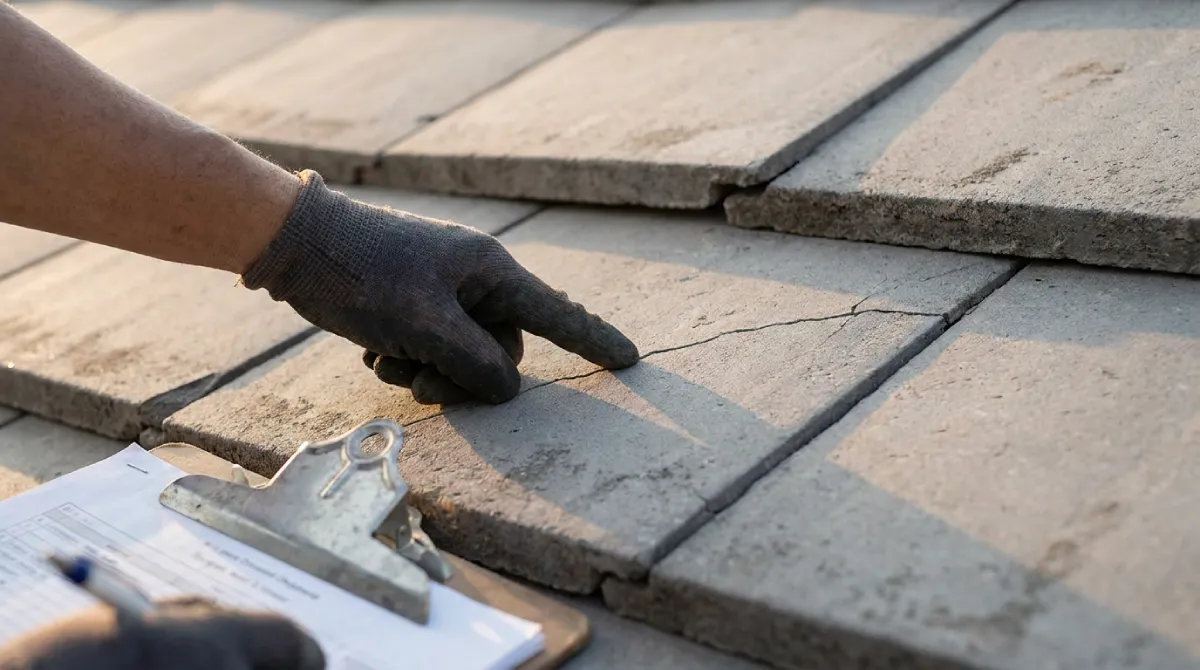
Not every roof showing wear needs full replacement. The most common reasons OC homeowners come to us for a roofing decision:
- Slipped or broken tiles from Santa Ana winds. The Santa Ana wind season (October through February) loosens tiles every year. A handful of cracked or displaced tiles can usually be repaired for $500–$2,000.
- Underlayment failure under intact tiles. This is the most common hidden problem on 25+ year old tile roofs. The tiles look fine from the street, but water is finding its way through degraded felt. A tile re-lay solves this for $8–$12 per square foot less than full replacement.
- Flashing failure at chimneys, vents, and valleys. Often the actual source of “roof leaks” on otherwise sound roofs. Targeted flashing repair runs $500–$3,000 depending on access.
- Salt-air corrosion of fasteners and metal accessories. A specific Newport Beach, Huntington Beach, and Laguna problem. Marine-grade fasteners and corrosion-resistant flashing matter more than the roofing material itself in coastal applications.
The rule of thumb: if more than 30% of the roof field is failing — multiple slipped tile zones, widespread underlayment exposure, visible water damage or staining inside the home in multiple rooms — replacement usually wins on cost-per-year basis. Below that threshold, a targeted repair or tile re-lay is almost always the better financial decision.
Homeowners Insurance, Financing, and 2026 Rebate Programs
Will insurance cover your roof replacement?
Homeowners insurance typically covers roof damage from sudden events — storm damage, fire, falling trees, wind-driven loss. It generally does not cover normal wear-and-tear, age-related failure, or “deferred maintenance” failures. If your roof is past its expected lifespan and the underlayment has simply aged out, that’s almost always an out-of-pocket replacement rather than an insurance claim.
If you do have a covered loss, document everything before any repair work begins — date-stamped photos of the damage, any displaced tiles or debris on the ground, interior water damage, and the weather event itself. Most insurance claim denials trace back to insufficient documentation or work that started before the adjuster’s inspection.
For canyon and WUI-zone homeowners, insurance is an entirely separate concern. Many major carriers have restricted new policy writing in OC’s Very High Fire Hazard Severity Zones, and a Class A fire-rated roof has become a baseline underwriting requirement for the carriers still writing in those areas. A new tile or Class A shingle roof can directly improve insurability.
AB 38 disclosure at point of sale
If your OC home is in a High or Very High Fire Hazard Severity Zone and was built before January 1, 2010, California’s AB 38 requires the seller to provide a home-hardening disclosure and defensible-space compliance documentation when the property changes hands. A documented Class A roof installation becomes a real selling point in this disclosure.
The new California Safe Homes Act (AB 888)
Effective January 1, 2026, California established the California Safe Homes Act (AB 888) — a grant program administered by the California Department of Insurance.
The program helps qualifying homeowners pay for fire-safe roofing and Zone Zero defensible space mitigation (the 5-foot ember-resistant zone around a home). The application portal is expected to open in Spring 2026.
Specific grant amounts and per-home caps were not finalized as of mid-2026. The program targets low- and moderate-income homeowners in high-risk fire areas. Check the California Department of Insurance website for current eligibility and application status before assuming you’ll qualify.
Financing options
For homeowners not financing through insurance proceeds, the main paths are home equity lines of credit (HELOCs), cash-out refinancing, manufacturer rebate programs (GAF, CertainTeed, Eagle Roofing Products all run periodic promotions), and 0% contractor financing for qualified borrowers. Papaya Construction Group works with several financing partners to structure projects across budget profiles.
How to Vet an Orange County Roofing Contractor
Before signing anything, confirm:
- Active CSLB license — C-39 (roofing) or B (general) classification.
- Current workers’ compensation insurance. Verify directly with the carrier, not just the certificate
- Multiple quotes. Get at least three written quotes from CSLB-licensed contractors before signing. Wildly low bids usually mean shortcuts on tear-off, underlayment grade, or permit pulls
- Tile sourcing in writing. Especially for HOA-governed homes with strict profile/color match requirements
- Documented WUI experience if your home is in a fire zone — ask for project addresses
- Multiple recent OC references within the past 12 months, not just generic “we’ve been in business since X” claims
- Itemized written quote including tear-off, decking allowance, underlayment grade, manufacturer warranty, and permit pull responsibility
Frequently Asked Questions
Plan Your Orange County Roof Replacement With Papaya Construction Group
Papaya Construction Group is a licensed Orange County general contractor (CSLB #1139140) based in Irvine. We handle full roof replacement, tile re-lay, repair, and exterior projects across Orange County, including HOA-governed communities and Very High Fire Hazard Severity Zones. Every project starts with a no-pressure assessment and a fully itemized written quote.
Schedule a free roof assessment at (949) 400-0032 or request your personalized Orange County roof replacement quote.
Papaya Construction Group · 2020 Main St Ste 1204, Irvine, CA 92614 · CSLB #1139140