
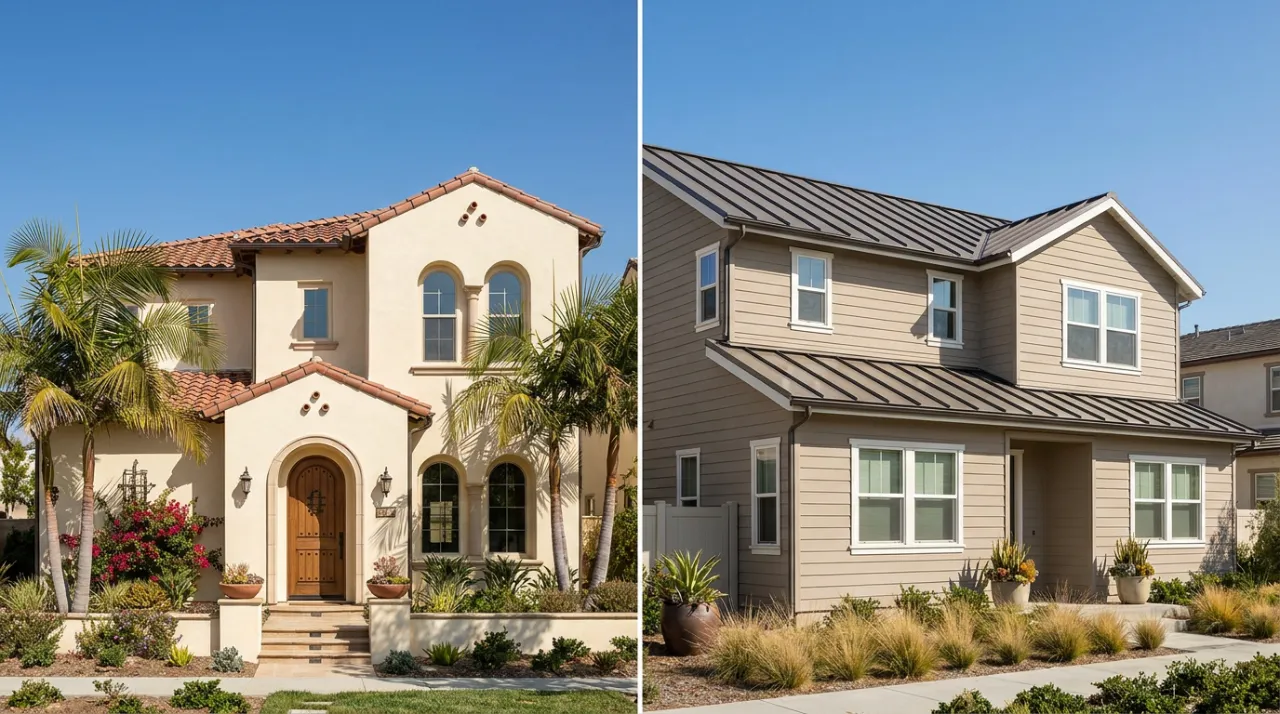
Written by the Papaya Construction Group team — licensed Orange County exterior contractor, CSLB #1139140.
Ask five Orange County contractors whether to recoat your stucco or rip it off for Hardie and you’ll get five answers — most of them shaped by what that contractor happens to sell. The honest answer is that neither material wins everywhere in OC.
Stucco and fiber cement each have a climate they’re built for, and the line between those climates runs right through this county, roughly where the salt air stops biting and the inland heat takes over.
That’s why the stucco vs siding question for Orange County, California homes has a different answer than the national comparison articles give.
This guide is the comparison we wish every OC homeowner had before they signed a bid. It covers:
- How each system actually performs in coastal salt-air zones versus inland UV-and-heat zones
- What the CSLB license requirement actually is
- How OC master-planned HOAs treat material changes
- What the real 2026 numbers look like
- Where each material genuinely belongs
If your existing stucco walls are structurally intact, the right move is usually a recoat from an Orange County stucco contractor — not a six-figure siding replacement. If you’re a block from the sand in Newport or Laguna and rebuilding anyway, the answer probably isn’t stucco. The middle is where this gets interesting.
The Short Answer for Stucco vs. Siding in Orange County, California
For most inland OC homes — Irvine, Anaheim, Yorba Linda, Tustin, the bulk of the master-planned communities — properly installed three-coat stucco performs as well as anything on the market and costs less to repair when it cracks.
For coastal OC homes within roughly a mile of the water — Newport Beach, Huntington Beach, Laguna Beach, Dana Point — fiber cement siding (specifically Hardie’s HZ10 product line, which is engineered for the hot, dry, salty West) has real performance advantages that get more pronounced the closer you live to the ocean.
Between those two zones, the decision tilts on aesthetics, HOA constraints, budget, and how long you plan to own the home.
The rest of this article is the work behind that summary.
Why Orange County Is Its Own Conversation
National articles comparing stucco and fiber cement tend to flatten the question to “which is better.” That framing fails OC homeowners because it ignores how dramatically conditions change across a 40-mile drive. The exterior cladding that performs beautifully in Anaheim Hills can fail prematurely in Corona del Mar, and vice versa.
Three OC-specific factors drive that:
How Each System Actually Performs
The honest fiber cement siding vs stucco comparison comes down to material science, not marketing. Both are cementitious systems with strong fundamentals, and both have failure modes that show up under specific conditions. Here’s what each is actually doing on your wall.
Three-Coat Stucco
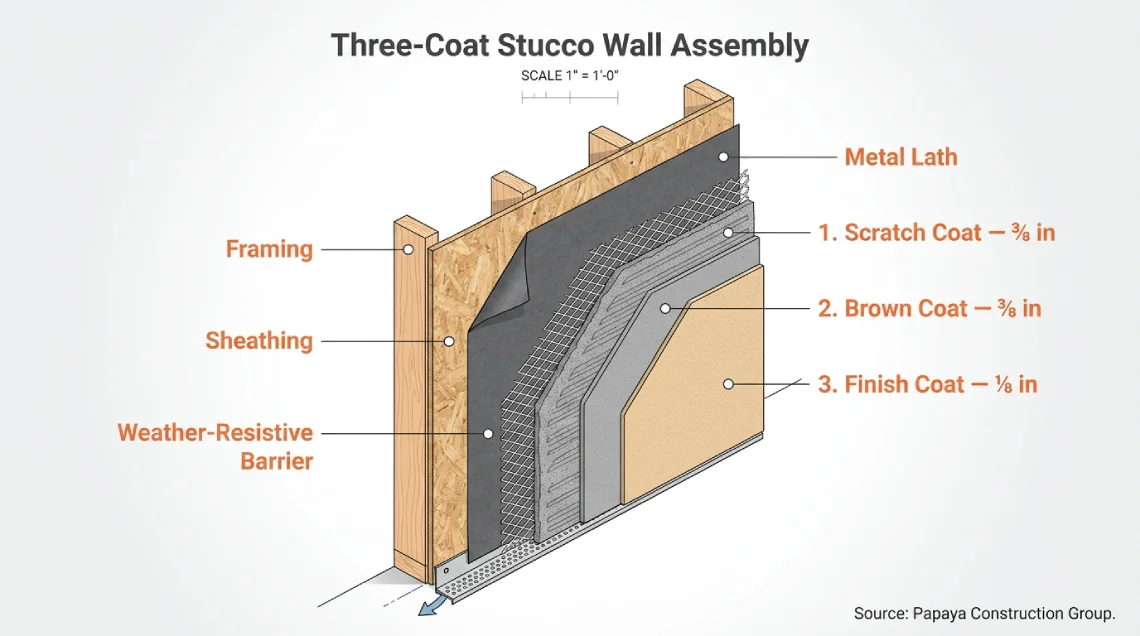
Traditional stucco is a Portland cement-based plaster system applied in multiple coats over metal lath attached to the framing — the scratch coat (the rough first pass that keys into the lath), the brown coat (which levels the wall and builds thickness), and the finish coat (which carries the color and texture).
The whole system goes over a weather-resistive barrier and weep screed at the base, with proper flashing at every penetration.
Finish textures range from heavy hand-trowel work to smoother options like skip trowel or the popular Santa Barbara finish, which gives walls a flatter, more refined look common on coastal OC remodels.
Stucco application is labor-intensive and skill-dependent — the difference between a 20-year wall and a 60-year wall is often the crew, not the material.
Properly installed, the system is monolithic — a continuous shell that wraps the house and contributes to the wall’s structural integrity.
It’s Class A fire-rated (a stucco-on-frame assembly meeting ASTM E119 testing can carry a 1-hour fire resistance rating), holds up extremely well in dry inland climates, and can deliver a 50-to-80-year service life when maintained.
Stucco has been the dominant residential cladding in coastal California for over a century, and the long-term track record is real.
Maintenance is the catch: stucco cracks. All stucco cracks. Hairline movement at corners, around windows, at the foundation line — it’s not a defect, it’s the material doing what cement does when wood frames behind it move with seasonal humidity and temperature changes.
Add California’s chronic low-grade seismic activity to the mix and OC stucco walls earn their hairline cracks faster than stucco in non-seismic climates.
If hairline cracks become widening cracks, or if the same crack keeps reopening after repair, that’s often a sign of building settlement that needs evaluation by an Orange County foundation repair contractor before any stucco fix will hold.
Stucco maintenance is straightforward but non-negotiable: periodic crack inspection and prompt sealing with elastomeric caulk — a flexible sealant that bridges the gap and moves with the wall — keeps water intrusion from migrating behind the shell.
On a roughly 7-to-10-year cycle, the wall also needs fresh elastomeric paint to keep its primary moisture management intact, which is where a qualified exterior house painting Orange County crew earns its keep.
Once moisture intrusion gets behind stucco, it’s stuck there. Trapped moisture causes moisture damage that rots sheathing, corrodes fasteners, and feeds mold long before any stain shows on the interior.
Fiber Cement / Hardie HZ10
Fiber cement siding is a composite of Portland cement, sand, and cellulose fibers pressed into planks (lap siding), panels (board-and-batten), or shingles.
Compared to traditional stucco, the two materials share a cementitious foundation but install very differently.
James Hardie — the dominant brand by a wide margin — engineers its product by climate zone, and the HZ10 product line is the formulation built for hot, dry, high-UV Western climates including coastal California. HZ10 is ASTM E136 noncombustible (it does not contribute to flame spread), is termite-resistant, and carries a 30-year limited, non-prorated, transferable substrate warranty.
Fiber cement costs more upfront than vinyl but earns the premium back in durability and lower long-term upkeep.
Hardie’s ColorPlus Technology — a factory-baked finish — carries a separate 15-year limited finish warranty and tends to outperform field-applied paint on color retention and fade resistance, which matters under inland sun.
Many quality installations now use a rain screen detail (a small drainage gap behind the boards) that lets the wall dry faster after rain events — a meaningful upgrade for walls facing weather.
Fiber cement isn’t perfect. It’s heavier than vinyl or wood, requires specialized fasteners and cutting techniques (silica dust during cuts demands proper PPE), and the wall reads as segmented rather than monolithic — meaning you’ll have visible joints between individual boards and caulked seams at trim that need re-caulking on a roughly 10-to-15-year cycle.
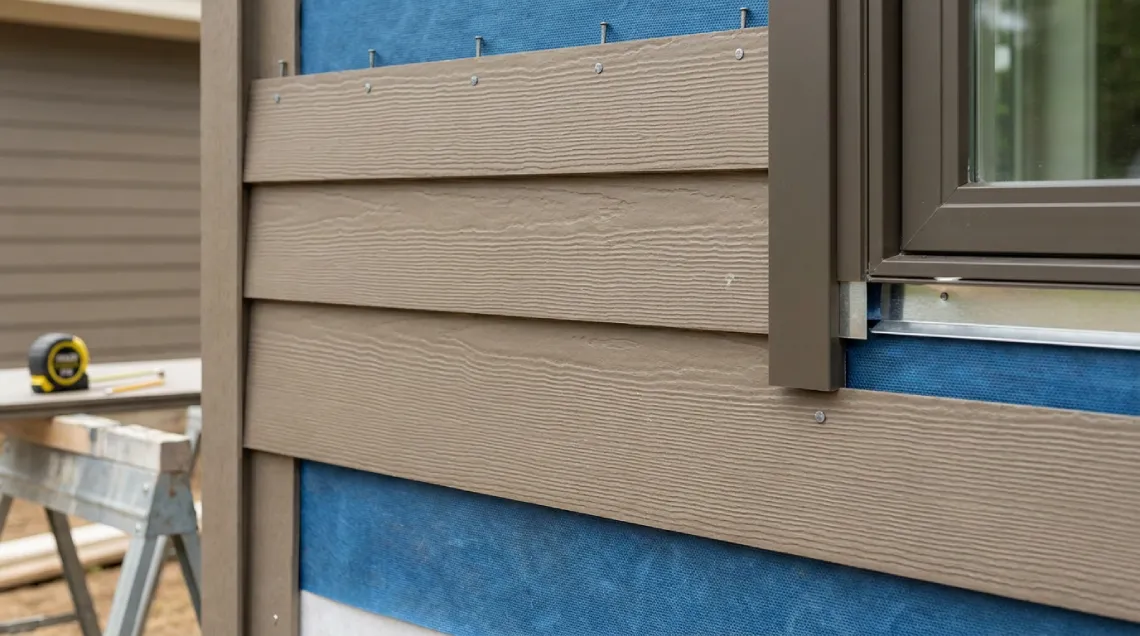
The flip side: when damage does happen, individual boards are easily repaired or replaced one-at-a-time, which is less maintenance over a 30-year ownership window than a stucco wall that needs whole-elevation patching for color match.
Coastal OC Homes: Newport Beach, Huntington Beach, Laguna Beach, Dana Point
If your home is within about a mile of the coast — Newport Beach (92660, 92661, 92663), Huntington Beach (92646, 92648, 92649), Laguna Beach (92651, 92677), or Dana Point (92624, 92629) — and the closer it is, the more this applies — the chronic salt-air exposure changes the math.
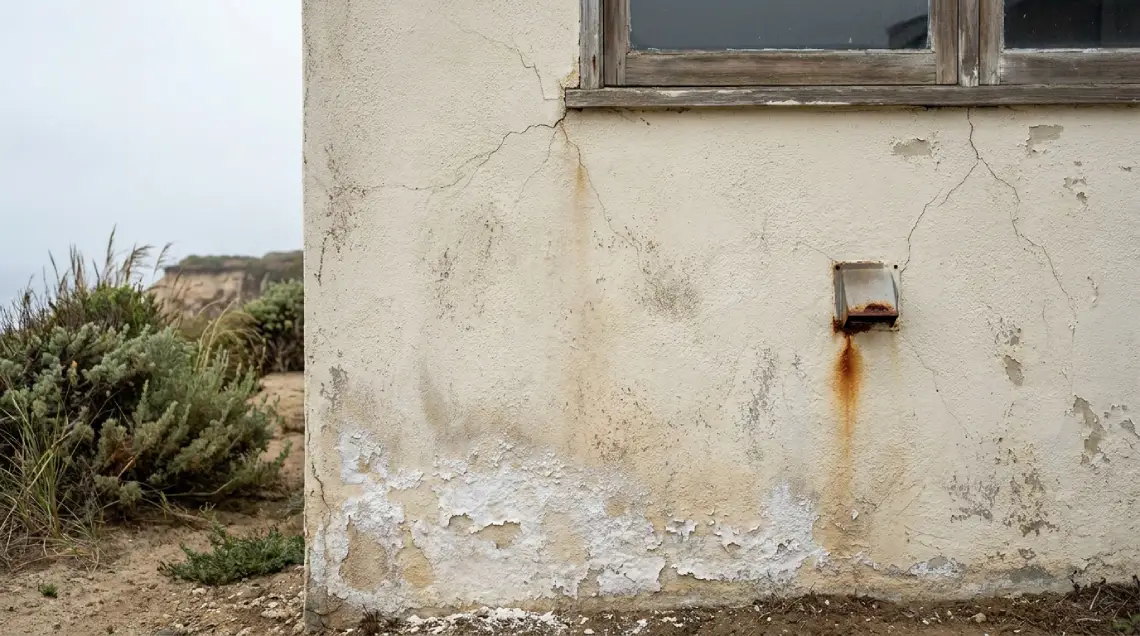
Stucco can be specified for coastal performance (denser mix, galvanized or stainless lath, more aggressive sealant maintenance), and there are plenty of stucco homes performing fine in Corona del Mar, Crystal Cove, and the Three Arch Bay end of South Laguna. But the maintenance discipline required is real, and the consequences of skipping it compound over decades.
Hardie HZ10 is purpose-built for exactly this environment. The board itself is cementitious but factory-cured, making it a genuinely low-maintenance cladding in salt-air zones — it doesn’t absorb and hold moisture the way a porous stucco wall can.
Compared to coastal stucco’s ongoing crack-and-seal cycle, Hardie HZ10 demands relatively low maintenance over its service life. It doesn’t feed efflorescence. It doesn’t rely on embedded metal lath in the cladding plane (fasteners are still metal, of course, and need to be the corrosion-resistant spec Hardie calls for in coastal HZ10 installations — that’s not optional).
For homes that are getting beaten with salt spray daily, this is the rare case where the marketing claim and the field performance line up — and when Hardie is installed over furring strips with a rain screen detail, the wall sheds salt-laden moisture even faster.
If you’re rebuilding cladding within a mile of the OC coast, fiber cement deserves a real look, and a qualified Hardie board installation in Orange County contractor can walk you through the spec.
The caveat: if your coastal home is already stucco and the substrate is intact, ripping it off to install Hardie is a major project — easily $40,000 to $80,000 on a typical OC home, depending on size and detailing.
A targeted stucco repair-and-recoat program can extend the life of the existing system for a fraction of that cost, and may be the right call if you’re not planning to own the home for another 20 years. The right answer depends on your timeline and your tolerance for ongoing maintenance, not on which material is “better” in the abstract.
Inland OC Homes: Irvine, Anaheim, Yorba Linda, Tustin
This is stucco’s home turf. Dry inland climate, hot summers, cool dry winters, minimal salt exposure, and an architectural vocabulary that’s been built around stucco for sixty years.
Drive through Irvine (92602, 92614, 92618, 92620), Anaheim Hills (92807, 92808), Yorba Linda (92886, 92887), or Tustin (92780, 92782) and the dominant visual is a continuous stucco surface punctuated by tile roofs, arched windows, wrought iron, and the occasional accent stone — that’s not coincidence, that’s the climate and the master plan speaking through the material.
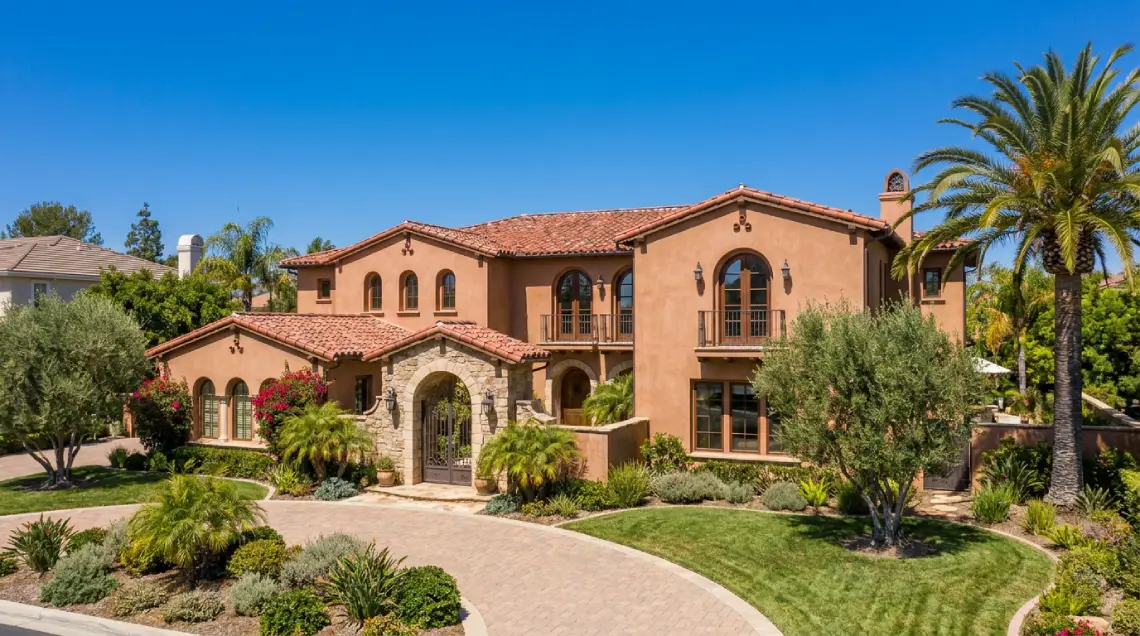
For inland homes, the case for switching from stucco to Hardie is weaker on technical grounds. Both materials perform well here. The case for Hardie inland is mostly aesthetic — homeowners who want a Craftsman, modern farmhouse, or board-and-batten look on a home that’s currently stucco. That’s a valid reason; just don’t sell it to yourself as a durability upgrade, because it isn’t one in this climate.
If your inland stucco is showing its age, a competent stucco recoat over a sound substrate typically runs $6 to $10 per square foot — versus $12 to $18 per square foot to tear off and install Hardie.
The cost gap is large enough that for many inland homeowners, the right move is hiring a stucco contractor in Irvine or your inland city to recoat what’s already there, then putting the saved capital into windows, Orange County roof repairs if your roof is aging, or interior work that delivers more value per dollar.
What About Vinyl Siding?
A quick note on the third option many OC homeowners ask about: vinyl siding. The 2025 Cost vs Value Report puts vinyl siding replacement at 97% national ROI, and installed cost typically runs $4.50 to $8.50 per square foot — meaningfully cheaper than either stucco or fiber cement. For some homeowners in specific situations, that price gap is the deciding factor.
But for most OC homes, vinyl runs into three real problems:
- HOA restrictions. A large share of OC master-planned communities prohibit vinyl outright or limit it to specific architectural details (gable accents, board-and-batten in approved colors). Read your CC&Rs before you price it.
- Fire-zone limitations. Vinyl’s lower fire resistance — it can warp and melt in extreme heat — disqualifies it from most Chapter 7A Wildland-Urban Interface (WUI) construction. After the post-2026 California fire maps tightened, that limitation matters in more OC neighborhoods than it used to.
- Architectural fit. OC’s dominant aesthetic vocabulary — Spanish, Mediterranean, contemporary monolithic, mid-century modern — doesn’t read right with vinyl. Vinyl’s place in OC is mostly modest tract builds, ADUs, garage exteriors, or back-of-house elevations that don’t drive curb appeal. Insulated vinyl variants address some of the energy-efficiency gap but don’t fix the aesthetic or fire-resistance issues.
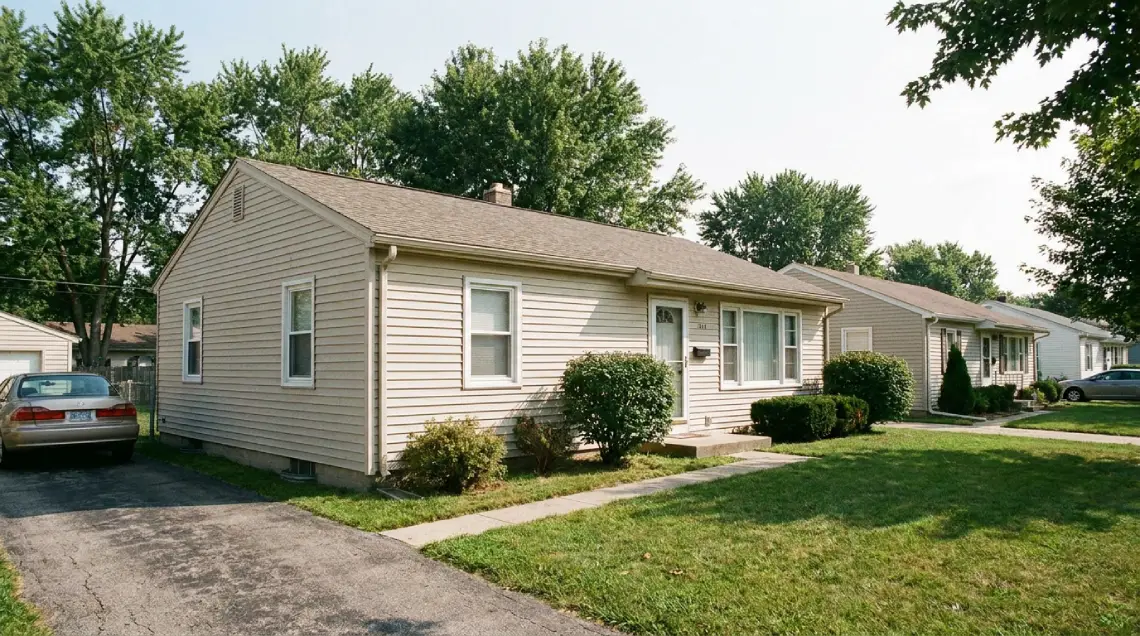
If vinyl is on your shortlist and your HOA allows it, get a competing bid alongside fiber cement. But in OC specifically, the value math usually still favors Hardie unless the budget gap is the only deciding factor — which is why the rest of this comparison stays focused on stucco vs fiber cement.
The Decision Framework
This is the heart of the article. When OC homeowners ask the Hardie board siding vs stucco question, the answer almost always tilts on proximity to the coast, the home’s existing architecture, and what the HOA allows. Find the row that describes your situation; the recommended action is what we’d tell a friend in that exact spot.
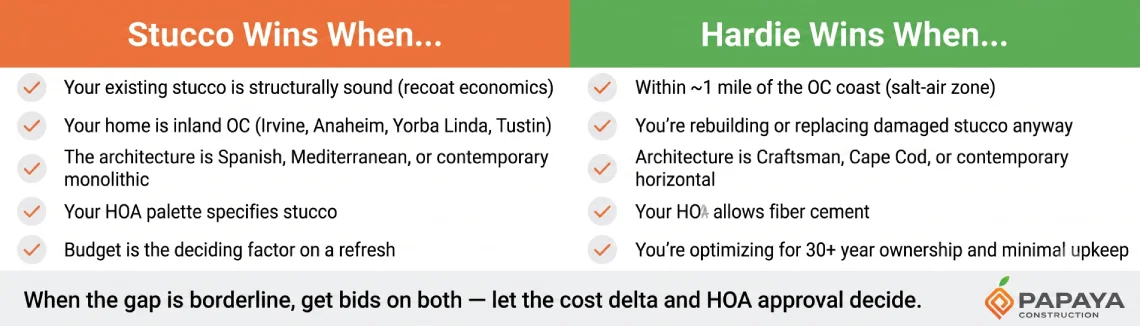
In short: stucco wins for homes with existing sound stucco, inland OC climates (Irvine, Anaheim, Yorba Linda, Tustin), Spanish/Mediterranean/monolithic architecture, and budget-constrained refreshes. Fiber cement (Hardie) wins for coastal salt-air zones (Newport Beach, Huntington Beach, Laguna Beach, Dana Point), Craftsman/farmhouse architecture, maximum resale ROI, and replacements where termite resistance is a priority. For fire-zone rebuilds and HOA-restricted communities, the choice depends on community-specific rules and aesthetics.
HOA Approvals Across OC Master-Planned Communities
If you live in a master-planned community, your HOA’s Architectural Review Committee — sometimes called an ARC, ARB, or Design Review Board — has real authority over visible exterior changes, and that authority is backed by California’s Davis-Stirling Act (Civil Code §4765), which requires HOA architectural review to be “fair, reasonable, and expeditious” but does not invalidate the underlying ability to deny non-conforming material changes.
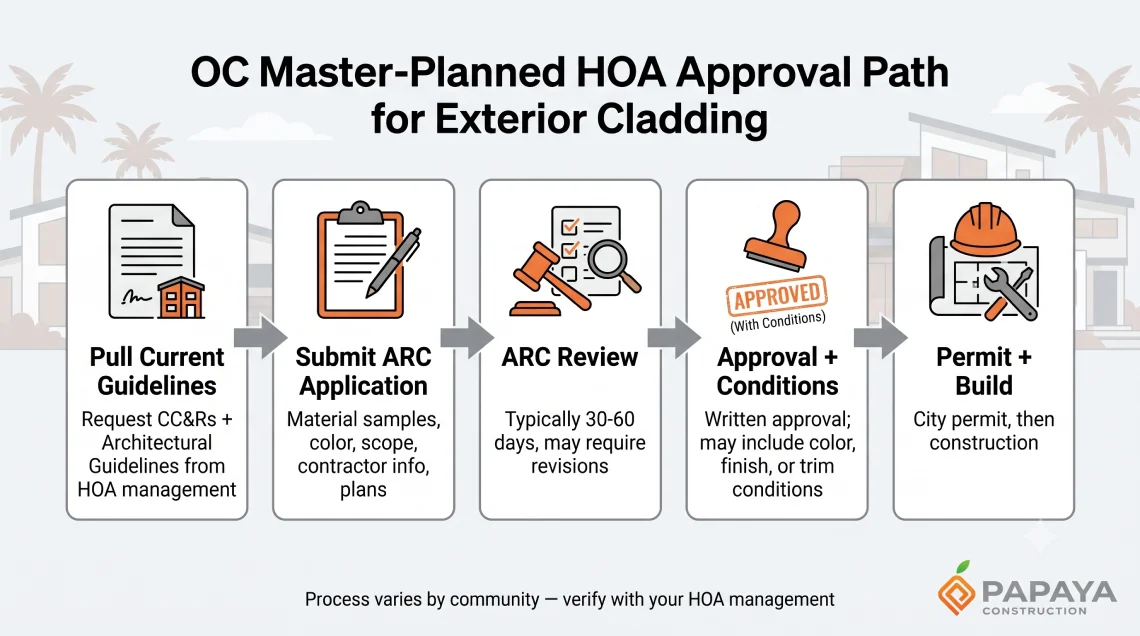
In practice, what we see across OC communities:
- Like-for-like replacement is straightforward. If your home is currently stucco and you’re recoating or repairing while matching the existing texture and a similar finish color, ARC review is usually a formality — turnaround in two to four weeks, often faster. That’s a real advantage of staying with what you have. An experienced OC stucco crew that’s worked your community before will already know the ARC paperwork and color palette.
- Material changes get scrutinized. Switching from stucco to Hardie (or the other way) is a material change. The ARC will want material samples, color samples, photos of the current exterior, renderings or examples of the proposed result, and contractor information. Some communities approve material changes readily; some restrict to a defined palette of approved materials. Read your CC&Rs and your community’s Architectural Guidelines before you spend a dollar on bids.
- Common OC ARC patterns: Communities built in the 1970s and 80s (Woodbridge, much of Mission Viejo, parts of Irvine) often have stucco as the default expectation but allow combining stucco with approved siding accents on gables, dormers, or board-and-batten details. Newer communities (Quail Hill, Portola Springs, parts of Ladera Ranch) may have broader material palettes including approved Hardie profiles in specific ColorPlus colors. Coastal communities (parts of Newport Coast, Dana Point gated communities) sometimes have stricter material rules to maintain architectural cohesion — and ironically, those rules may force stucco in environments where Hardie would perform better. Read the documents.
Quick HOA Tip
Before you commission bids, request your community’s current Architectural Guidelines from your management company in writing. Many communities update their material lists annually, and what was true in 2018 may not be true in 2026. A 15-minute read can save weeks of back-and-forth — or a denied application after you’ve already paid for plans.
The CSLB Licensing Question: What to Verify Before Signing
California requires anyone performing contractor work over $1,000 (raised from $500 effective January 1, 2025 under AB 2622) to hold a current CSLB license. For exterior cladding, three classifications matter:
- C-35 — Lathing and Plastering. The specialty license for traditional three-coat stucco work and all related plaster systems. A C-35 contractor can take a stucco-only contract on its own.
- C-61 / D-41 — Siding and Decking. The limited specialty license covering siding installation, including fiber cement. A C-61/D-41 contractor can take a siding-only contract on its own.
- B — General Building Contractor. A B-licensed contractor can take a multi-trade contract that includes stucco or siding as part of a larger scope — for example, a remodel that involves cladding plus structural plus exterior carpentry — and can self-perform those trades.
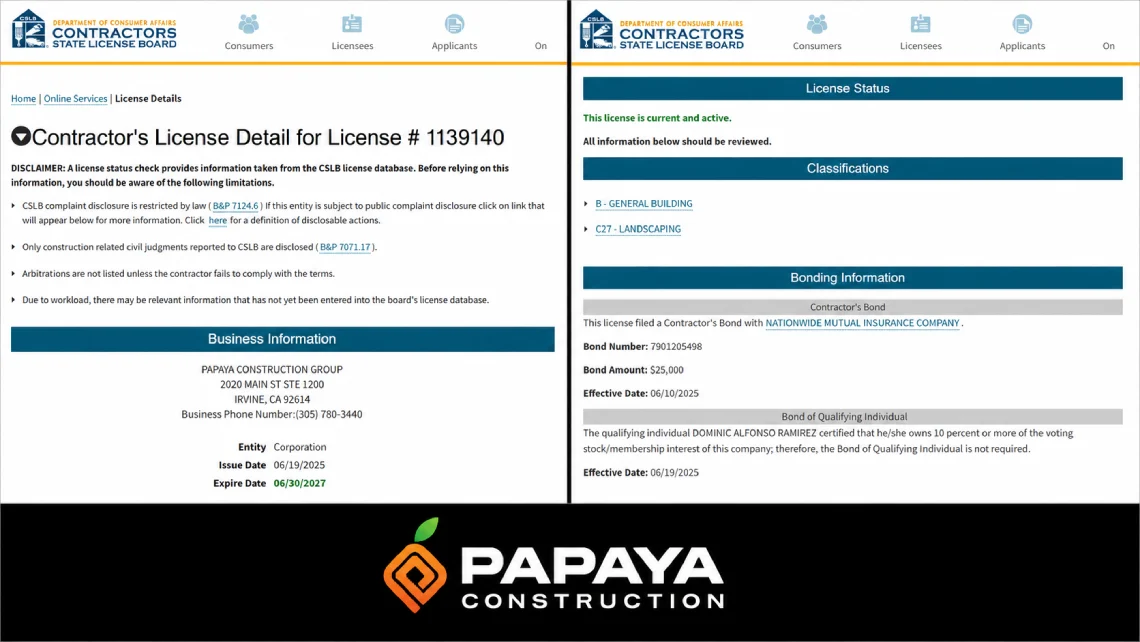
What a B license cannot do, under California Business & Professions Code §7057, is take a single-trade contract for stucco or siding alone, unless the B contractor also holds the appropriate specialty class. Many reputable OC general contractors hold a B plus one or more relevant specialty classes — that’s the combination you want to see for an exterior cladding project.
Verify any contractor on the CSLB license check tool before signing. The free search shows current license status, bond, workers’ comp coverage, and any complaint history.
It takes 60 seconds and protects you from a category of problems that don’t have any other prevention. If you want to know more about who you’d be hiring before you reach out, Papaya Construction Group publishes our license, classifications, and team background on the about page.
What It Costs in Orange County, 2026
OC labor rates run materially higher than national averages — roughly 30 to 50 percent higher for skilled exterior trades, which is what you’d expect in a region with this cost of living and this density of high-end homes. The numbers below are typical 2026 OC ranges for residential work, not edge cases.
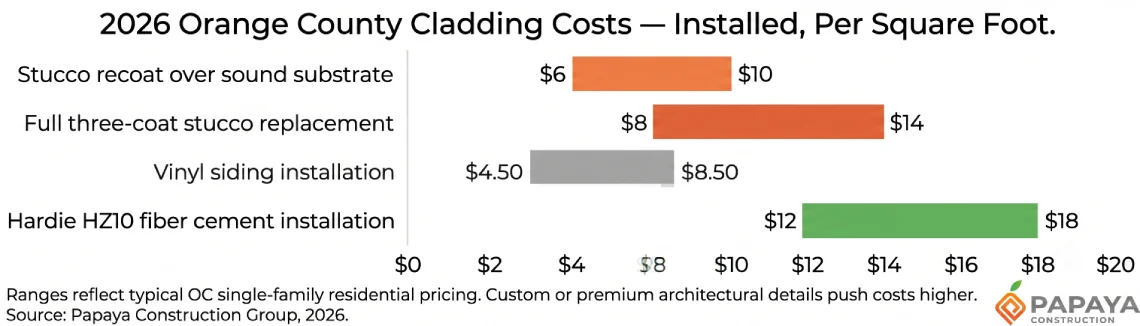
For homeowners pricing a full siding replacement project — meaning tear-off-and-replace, not recoat — expect the all-in number on a typical 2,200-square-foot OC home to land somewhere between $30,000 and $60,000 for Hardie. That’s a real number; the bids that come in significantly under it are usually missing something. Read the scope carefully.
Frequently Asked Questions
Final Word for OC Homeowners
The right answer to “stucco or Hardie?” in Orange County depends on where your house sits, what your HOA allows, what your home’s architecture is asking for, what your timeline looks like, and what your existing exterior is doing right now. There is no universal winner. Anyone who tells you there is — in either direction — is selling, not advising.
If your home is already stucco and the substrate is sound — where the stucco wraps the house in a continuous, intact shell — get a real assessment from an experienced Orange County stucco contractor before you commit to new siding or a six-figure cladding replacement.
A targeted repair-and-recoat program often delivers 15-to-25 more years of service for a fraction of the tear-off cost, refreshes your home’s curb appeal at a fraction of the cost of full replacement, and is the right move for most OC homeowners who aren’t replacing for purely aesthetic reasons.
Exterior design choices are easier to live with when you start from a sound, well-maintained shell.
If you’re at the coast and rebuilding anyway, take Hardie seriously — the engineering really does match the environment. And if you’re somewhere in between, the decision framework above is the most honest answer we can give.
Need an Honest Assessment of Your OC Home’s Exterior?
Papaya Construction Group is a fully licensed (CSLB #1139140), insured, and HOA-experienced Orange County exterior contractor. We’ll walk your home, document what’s there, and tell you straight what the right next step is — recoat, repair, or full replacement. No pressure, no upsell theater.
Get your Orange County stucco quote
- Papaya Construction Group
- 2020 Main St Ste 1204, Irvine, CA 92614
- (949) 400-0032